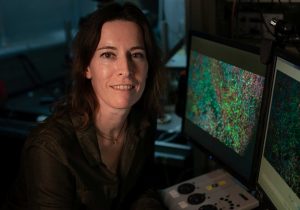
Neuroscience: New Study Reveals Genetic Link Between Autism and Schizophrenia
In the News A groundbreaking study led by Prof. Shani Stern (Sagol Department of Neurobiology) reveals that 75% of genes associated with autism spectrum disorder

 Dr. Judith Somekh (Department of Information Systems) recently identified a novel data science method that significantly shortens the identification of cell-surface receptor functions that are responsible for inter-cellular communication in the human body. This discovery may lead to the development of new receptor-targeting metabolic drugs. “Up until now, scientists have been using biological studies to uncover the functions of various receptors that can take multiple years,” explains Dr. Somekh. “The new method, based on network analysis of tens of thousands of values for gene expression, successfully predicts over 90% of the metabolic functions of different receptors, some of which were previously unknown.” The study, published in Scientific Reports, was covered in the Jerusalem Post. READ Press Release
In the News A groundbreaking study led by Prof. Shani Stern (Sagol Department of Neurobiology) reveals that 75% of genes associated with autism spectrum disorder

In the News University of Haifa is bestowing the Degree of Doctor of Philosophy, Honoris Causa, upon Mr. Isaac M. Dabah, leading businessman, philanthropist and dedicated

In the News A group of 22 students from the Ruderman MA Program for American Jewish Studies recently returned from the annual field trip to