
University of Haifa Launches Transformative Shared Society Center with a $5M Gift
In the News Photo: Michael and Linda Frieze with President Gur Alroey at the Honorary Doctorate Ceremony, March 2025. The Home Again campaign launched recently

 A unique study has for the first time documented the common process of a sequential feather replacement (feather molting) found among modern birds in a winged dinosaur dating back 120 million years. This finding has just been published in the journal Current Biology.
The finding shows that the dinosaur had highly-develop aerodynamic properties and may have lived in a habitat in which it faced predation risk or that it needed to maintain its flight capacities during molting. “It is fascinating to see how a mechanism that began to develop at least 120 million years ago also exist in today’s birds. It is also fascinating to see how we can use our modern knowledge about this mechanism in order to yield insights into the evolution and ecology of a dinosaur that lived 120 million years ago,” comments doctoral student Yosef Kiat of the Animal Flight Laboratory in the Department of Evolutionary and Environmental Biology, who led the study.
Birds must replace their feathers periodically in order to maintain their proper functioning. Once a feather reaches its full size it becomes a dead organ; the bird must then shed the old feather and sprout a new one in its place to ensure that its plumage remains functional – for example, for the purpose of flying. This process is known as molting. The molting strategy may indicate an ability to fly and provide clues about birds’ habitat. In species that spend much of their time in flight or in habitats exposed to predators (such as open areas with sparse vegetation that do not provide hiding places from predators), molting takes place in a gradual, sequential and slow manner in order to ensure that the birds maintain their flying capabilities even during the molting process. In birds that do not fly often, or that have access to numerous hiding places from predators without needing to fly, the process can be very rapid – the bird sheds a large number of feathers simultaneously and the entire molting process takes just two to three weeks.
In the News Photo: Michael and Linda Frieze with President Gur Alroey at the Honorary Doctorate Ceremony, March 2025. The Home Again campaign launched recently
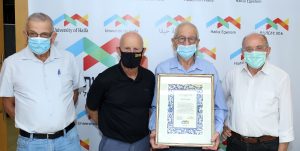
The University of Haifa is grateful to Mr. Dov Shafir, longstanding friend and supporter of the University of Haifa, for his generous gift to the

In the News Following a petition to Israel’s High Court, filed by the University’s Legal Clinics on behalf of students at Tel Hai and Sapir